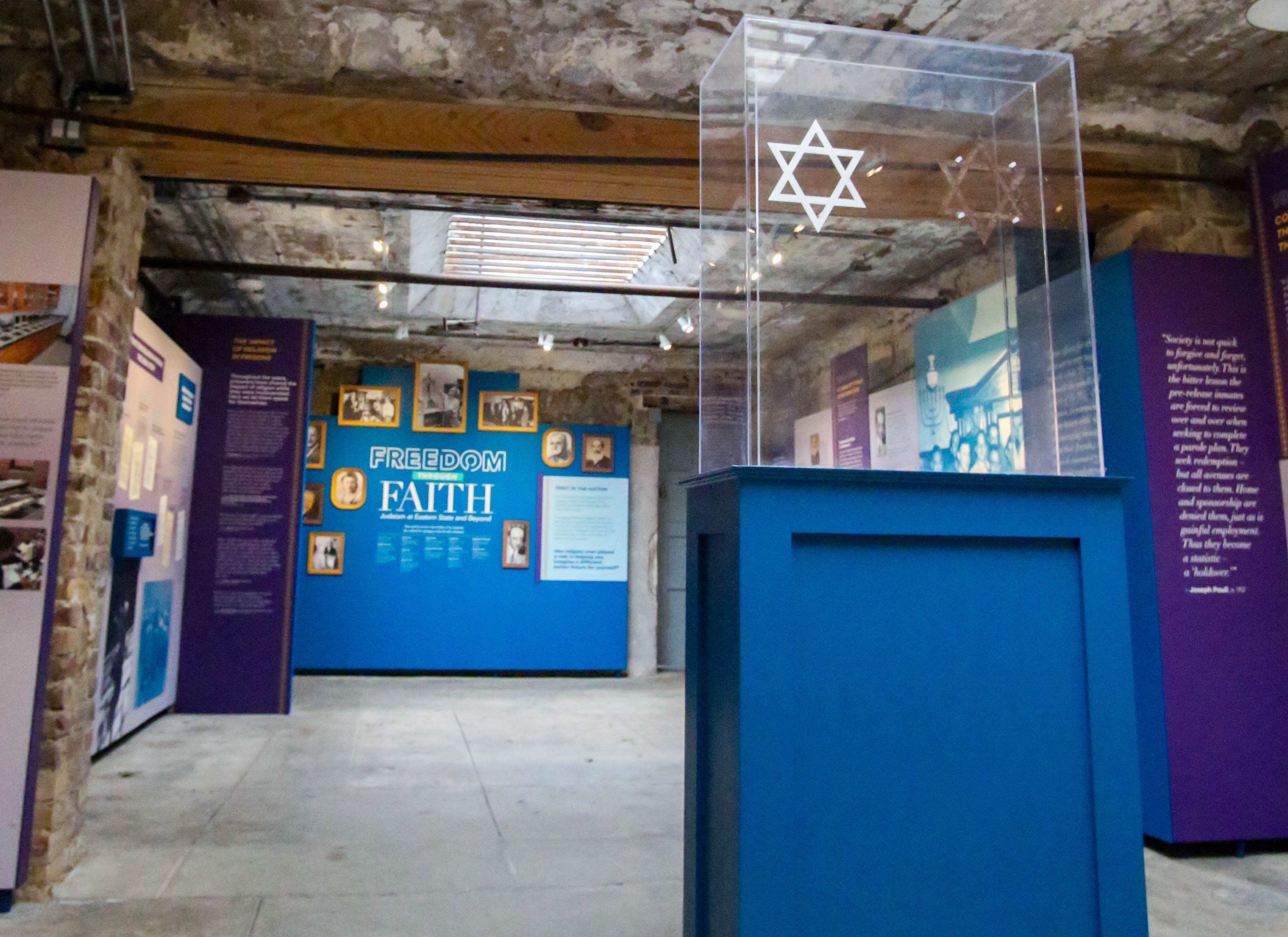
In 1922, incarcerated men and community volunteers built a synagogue at Eastern State Penitentiary – the first documented space dedicated to Jewish religious worship inside an American prison.
Freedom Through Faith: Judaism at Eastern State and Beyond is a groundbreaking new exhibit that explores this unique sacred space and examines its lasting legacy on religious freedom within incarcerated settings across the country over time.
When & Where
Permanent Exhibit. Open during all public hours.
Plan Your Visit
Freedom Through Faith is included with admission.
Become a Member
Members receive free admission and make exhibits like this possible.
Explore the Exhibit Content
Freedom through Faith reveals how religious freedom, framed as "unalienable rights," was a foundational promise of the Declaration that was strongly represented and practiced inside America’s first penitentiary, especially among its Jewish population. The exhibit explores how faith sustained dignity, community, and moral agency for incarcerated people, demonstrating how liberty of conscience persisted even within confinement.
Read on for select highlights from the exhibit content, and plan your visit today to experience the full exhibition in person.
These portraits are just a few members of the community who sustained the synagogue – inside the walls and beyond.
1829 – 1913: Birth of Jewish Life at Eastern State
Between 1880 and 1924, more than two million Jews fled persecution in Eastern Europe for the United States. Many arrived in Philadelphia to find economic hardship, social isolation, and prejudice. Stereotypes cast immigrants as prone to crime – and ignored the poverty and exclusion that shaped their lives.
Until the synagogue here opened, Christianity dominated the prison: ministers preached in the corridors, a Christian “Moral Instructor” made rounds, and the Bible Society distributed the New Testament. Cut off from family, neighborhood, and religious life, Jewish prisoners at Eastern State experienced “utter abandonment” and pressure to convert.
Image: Original illustration by Alina Josan, 2009.
Sabato Morais
Born in Italy in 1823, Sabato Morais arrived in Philadelphia in 1851 to lead Mikveh Israel, one of America's oldest congregations. Over nearly five decades, he championed striking workers, opposed Chinese exclusion, and protested the persecution of Armenians. His concern for the marginalized extended inside Eastern State's walls. Beginning in 1893, he visited Jewish prisoners personally, offering counsel, connecting men with their families, and supplying reading materials. Morais was driven by fear that prisoners cut off from community might abandon their faith entirely.
Listen to Rabbi S. Robert Morais read a letter from William Fraenkel to to his ancestor, Sabato Morais
Image and letter courtesy of the Library at the Herbert D. Katz Center for Advanced Judaic Studies, University of Pennsylvania.
1913 – 1929: A Community Forms at Eastern State
Jewish prisoners first gathered in the prison’s emergency hospital to pray as a community in 1913. This was the first known communal gathering in the prison’s history. By 1916, there were weekly Shabbat services. A 1917 article in The Jewish Exponent reported on the first Passover Seder inside Eastern State and described a Torah ark “built by the inmates themselves.”
The Alfred W. Fleisher Memorial Synagogue began as individual exercise yards that transformed first into a weaving shop, then into an informal synagogue in 1922. In 1928, chaplain Rabbi Isaac Feinberg engaged architecture firm Hoffman & Henon – with the support of interior decorator Kayser & Allman – to design the interior of the first synagogue in an American prison. The designs were ultimately implemented by two incarcerated men: Jacob Forbes and David Goldman.
Image: Philadelphia Record Photograph Morgue (Collection V07), Historical Society of Pennsylvania.
Alfred Fleisher
Alfred Fleisher became president of Eastern State's board of trustees in 1922, two years after the synagogue opened. Using his own funds, Fleisher established prison workshops, giving prisoners a means to earn money for themselves and for their families waiting outside. When Fleisher died suddenly in 1928, prisoners erected a bronze tablet to his memory and dedicated the synagogue in his name.
Image: Philadelphia Record Photograph Morgue (Collection V07), Historical Society of Pennsylvania.
1929 – 1950s: Community Through the Walls
Take a look at these letters and newspaper articles to see how spiritual life and ritual flourished in an unlikely setting.
Image: Joseph Paull Photographs (Collection PG129), Historical Society of Pennsylvania.
Donations like those of Joseph Paull, who owned a wholesale kosher meat business, provided both nourishment and ritual meals.
Joseph Paull Papers (Collection MSS044), Historical Society of Pennsylvania.
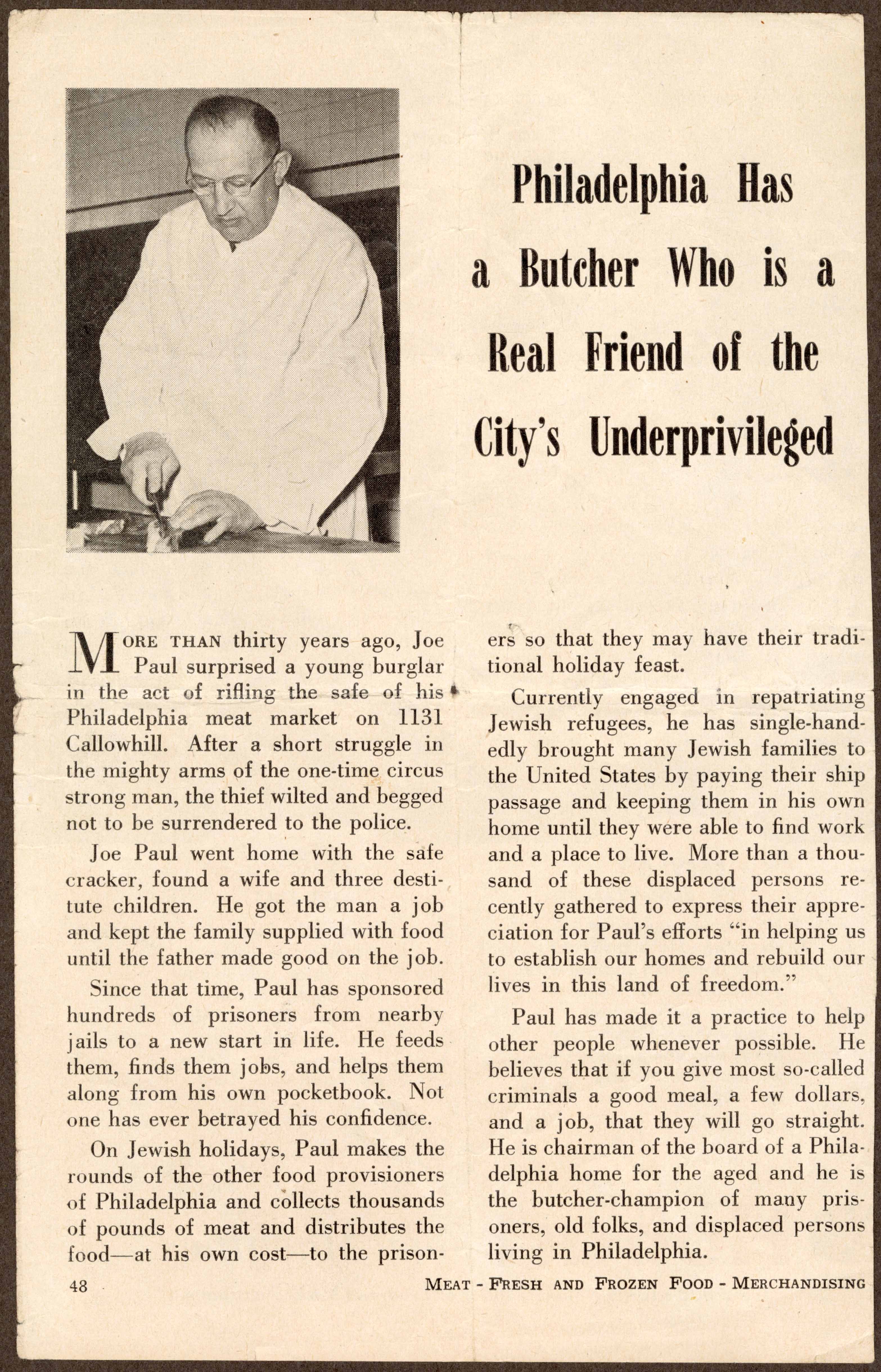
Deep relationships were formed through prison walls that sometimes led to sponsoring the release of prisoners like Morris Orenstein, who was widely praised for his exemplary conduct and role as “caretaker of the synagogue in the penitentiary.” Orenstein often wrote to Paull on behalf of the Jewish prisoners to thank him for his support.
Joseph Paull Papers (Collection MSS044), Historical Society of Pennsylvania.
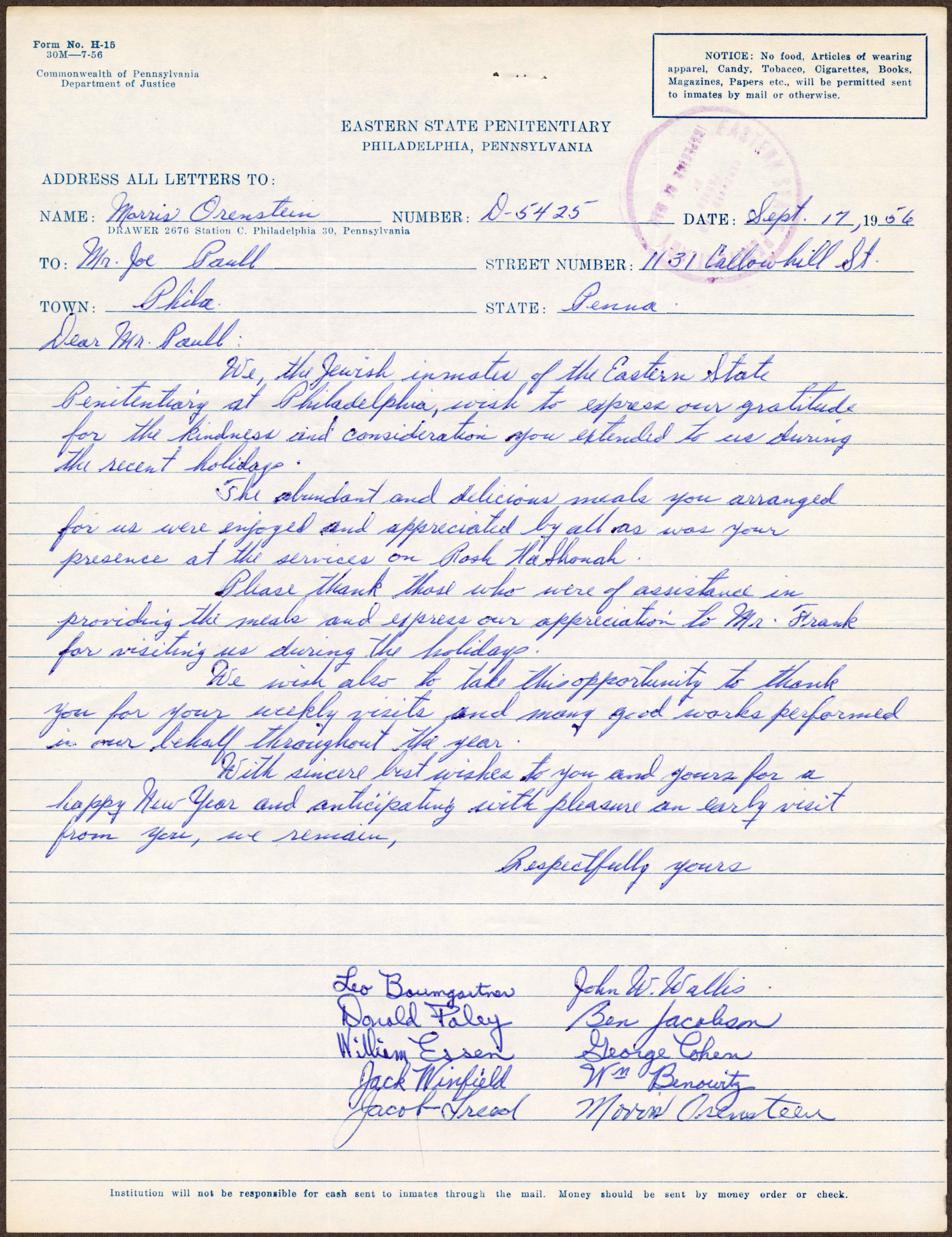
Outside advocate Joseph Paull formed a close bond with incarcerated congregant Morris Bolber, who died at Eastern State Penitentiary. Paull personally covered the costs to ensure Bolber received a Jewish funeral.
Joseph Paull Papers (Collection MSS044), Historical Society of Pennsylvania.
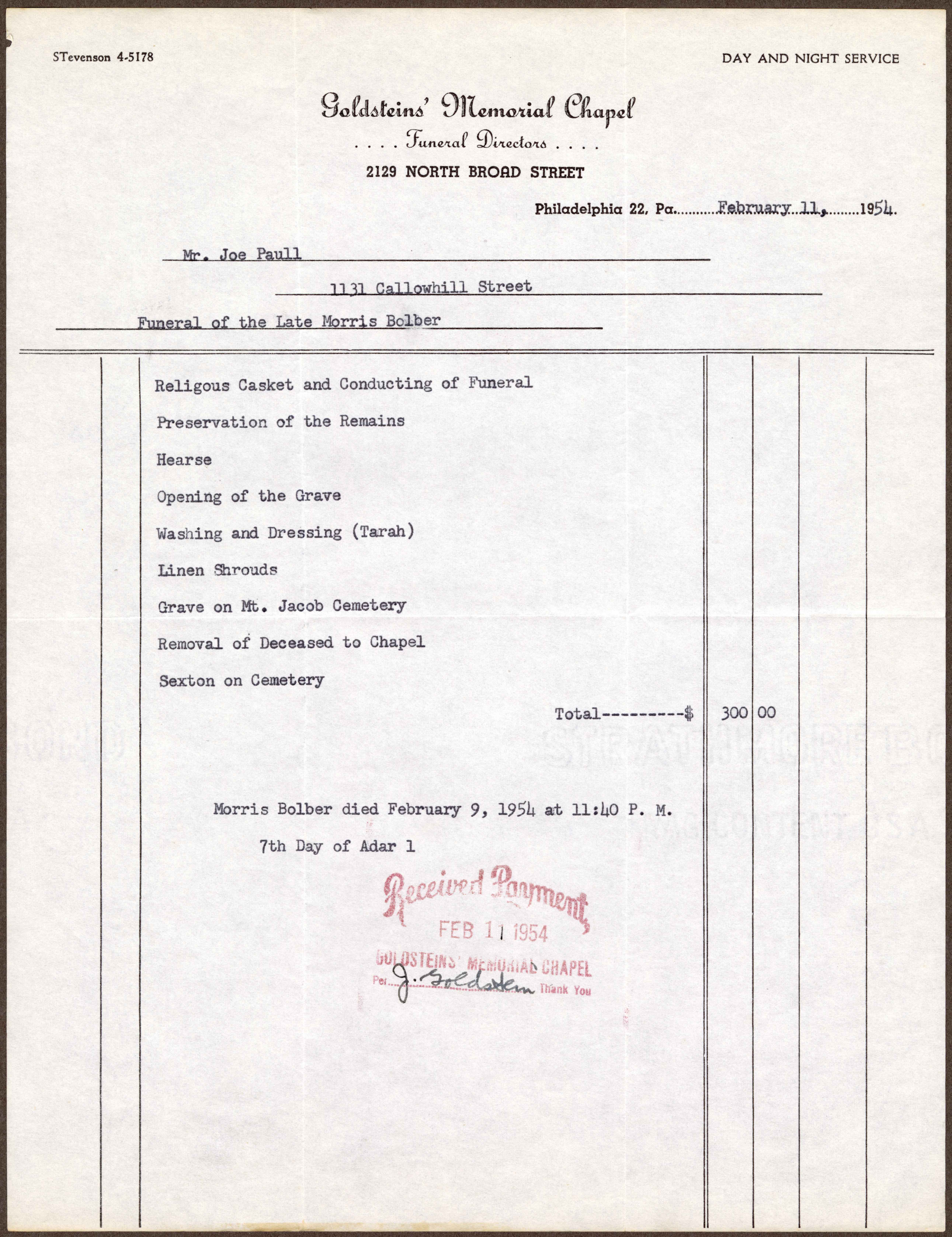
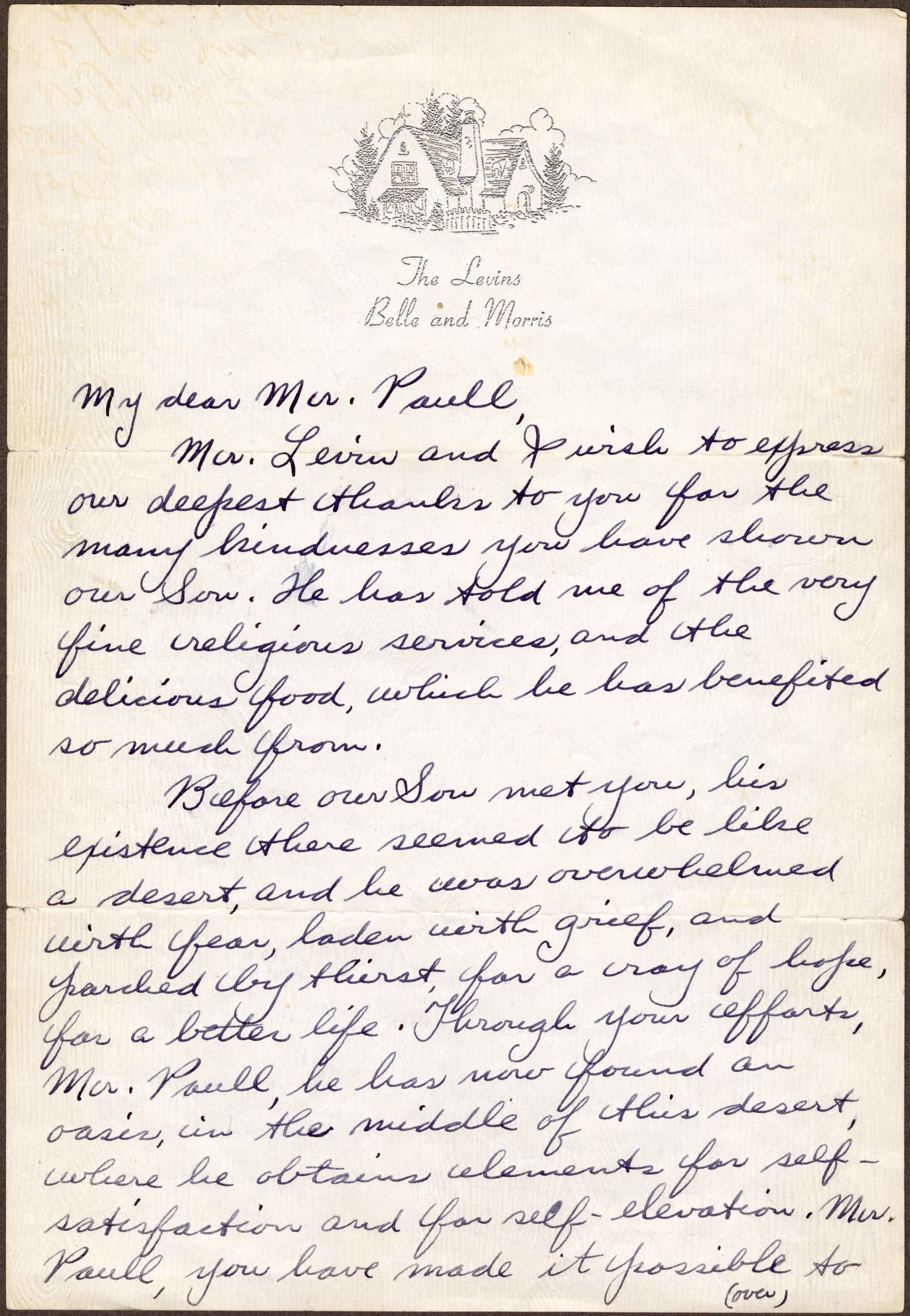
Seymour Levin was incarcerated at Eastern State as a teenager. His mother, Belle, describes the emotional cost of incarceration of family members.
Listen to a recording of Belle Levin's letter to Joseph Paull.
Joseph Paull Papers (Collection MSS044), Historical Society of Pennsylvania.
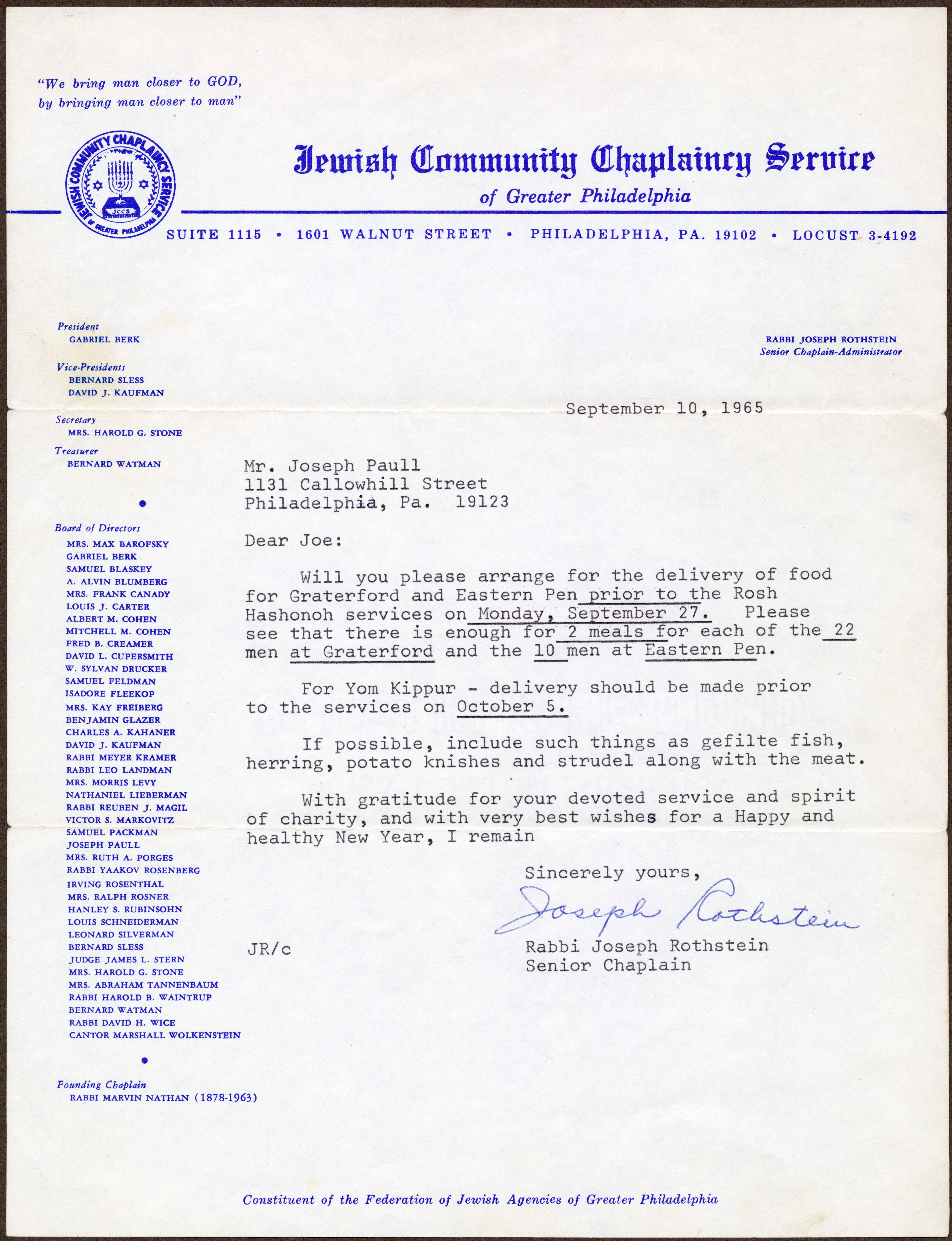
Jewish chaplains led services and coordinated ritual meals for holidays. They reached out to the broader Jewish community for help and coordinated ritual meals for holidays.
Joseph Paull Papers (Collection MSS044), Historical Society of Pennsylvania.
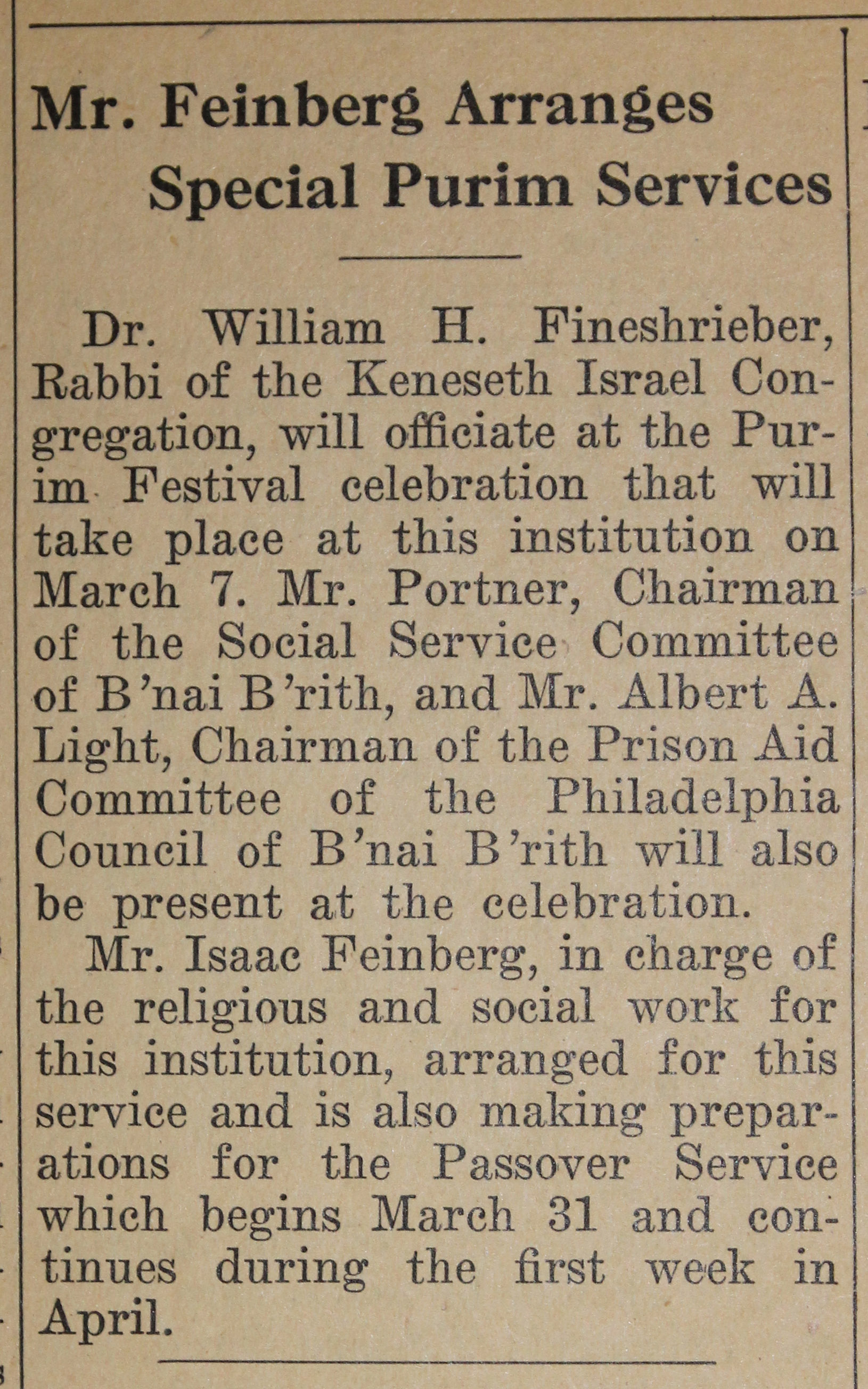
1934: Purim Festival takes place at Eastern State. Purim is a joyous holiday that affirms and celebrates Jewish survival and continuity throughout history through performances of skits and songs, noisemakers, and gifts of food.
From Pen Points, February 14, 1934. Collection of Eastern State Penitentiary Historic Site.
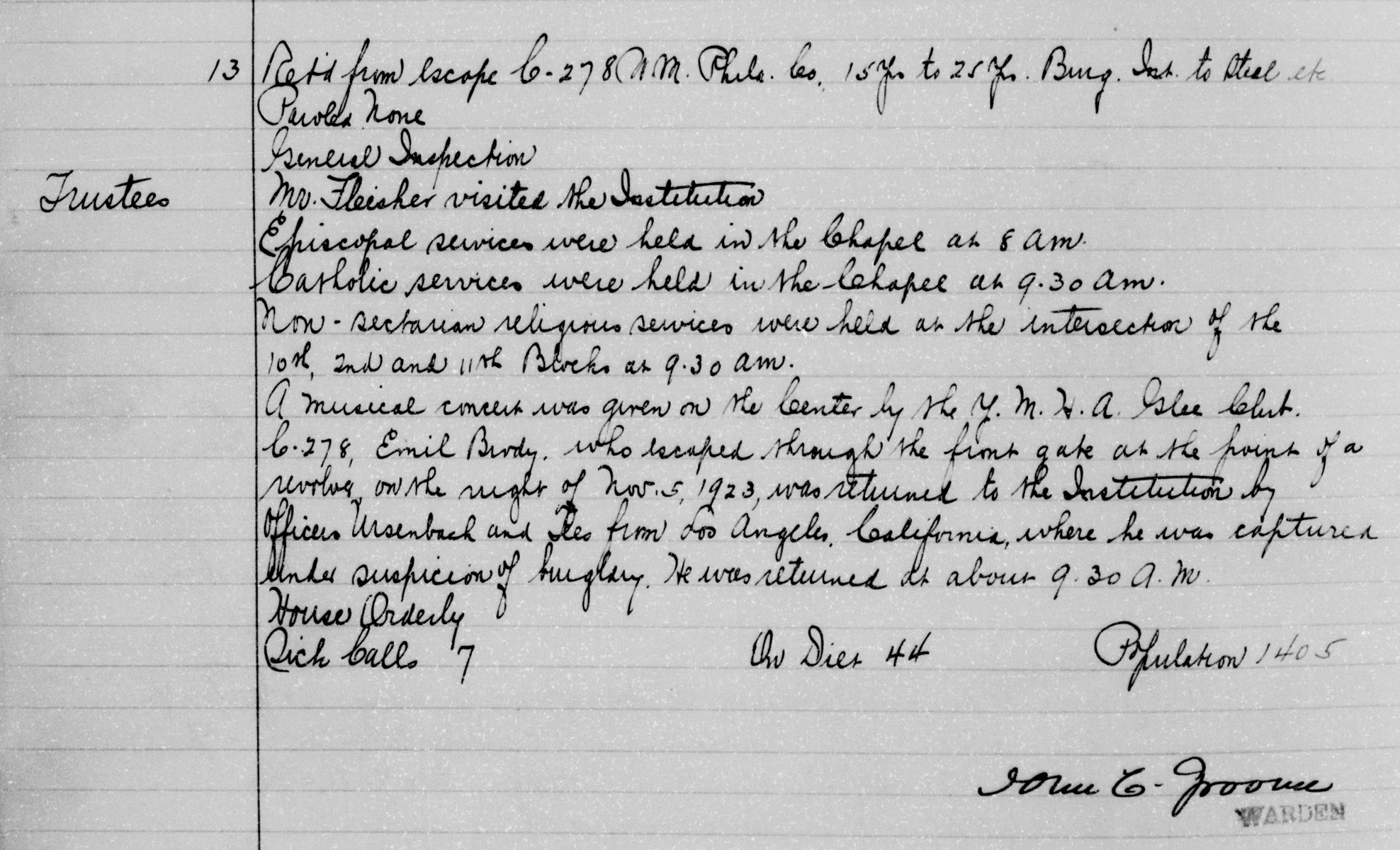
In 1925, Hanukkah was celebrated with a performance by the Young Men’s Hebrew Association Glee Club, followed in later years by theatrical performances during the eight‑day holiday honoring religious freedom.
Warden's Daily Journal, December 13, 1925.
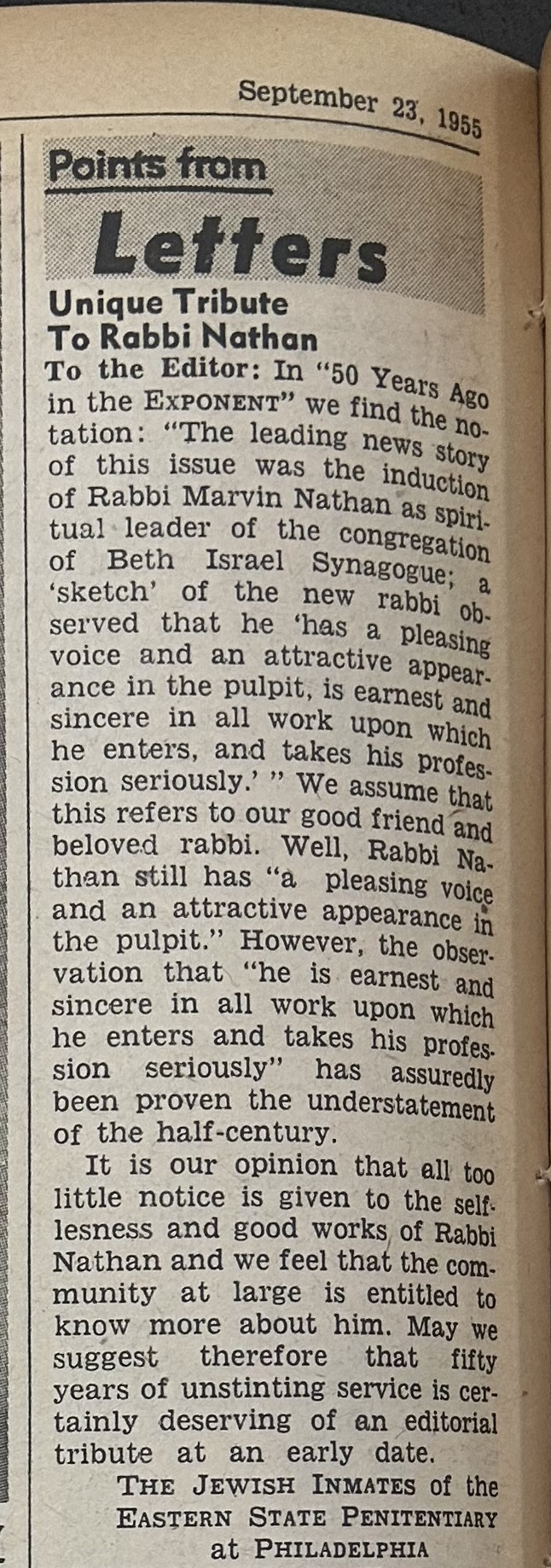
The incarcerated Jewish congregation at Eastern State wrote to the local newspaper in praise of Rabbi Marvin Nathan.
From The Jewish Exponent, September 23, 1955.
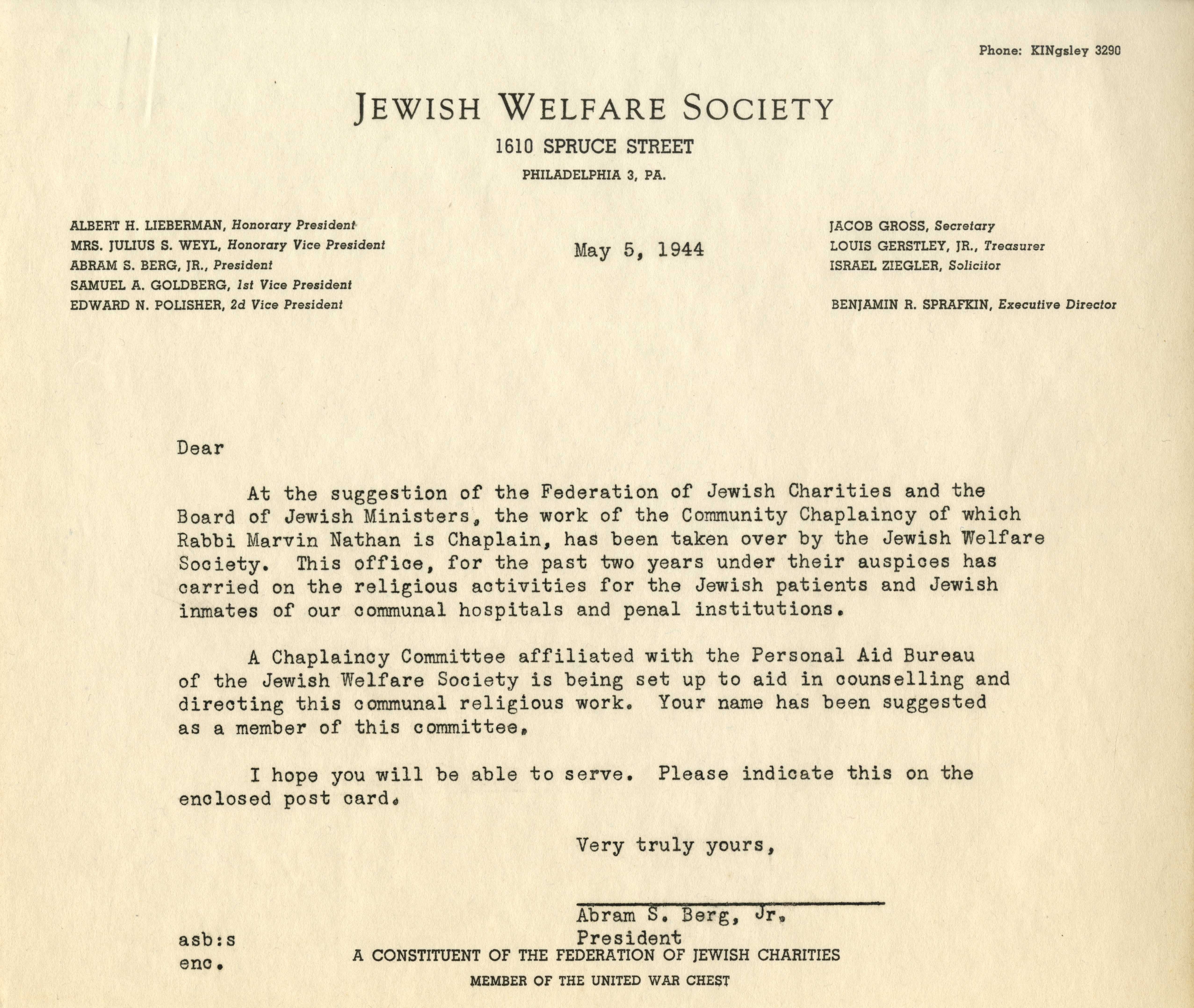
Anyone could volunteer with the Personal Aid Bureau to help organize holiday programs and offer emotional support.
Courtesy of Special Collections Research Center, Temple University Libraries, Philadelphia, PA.
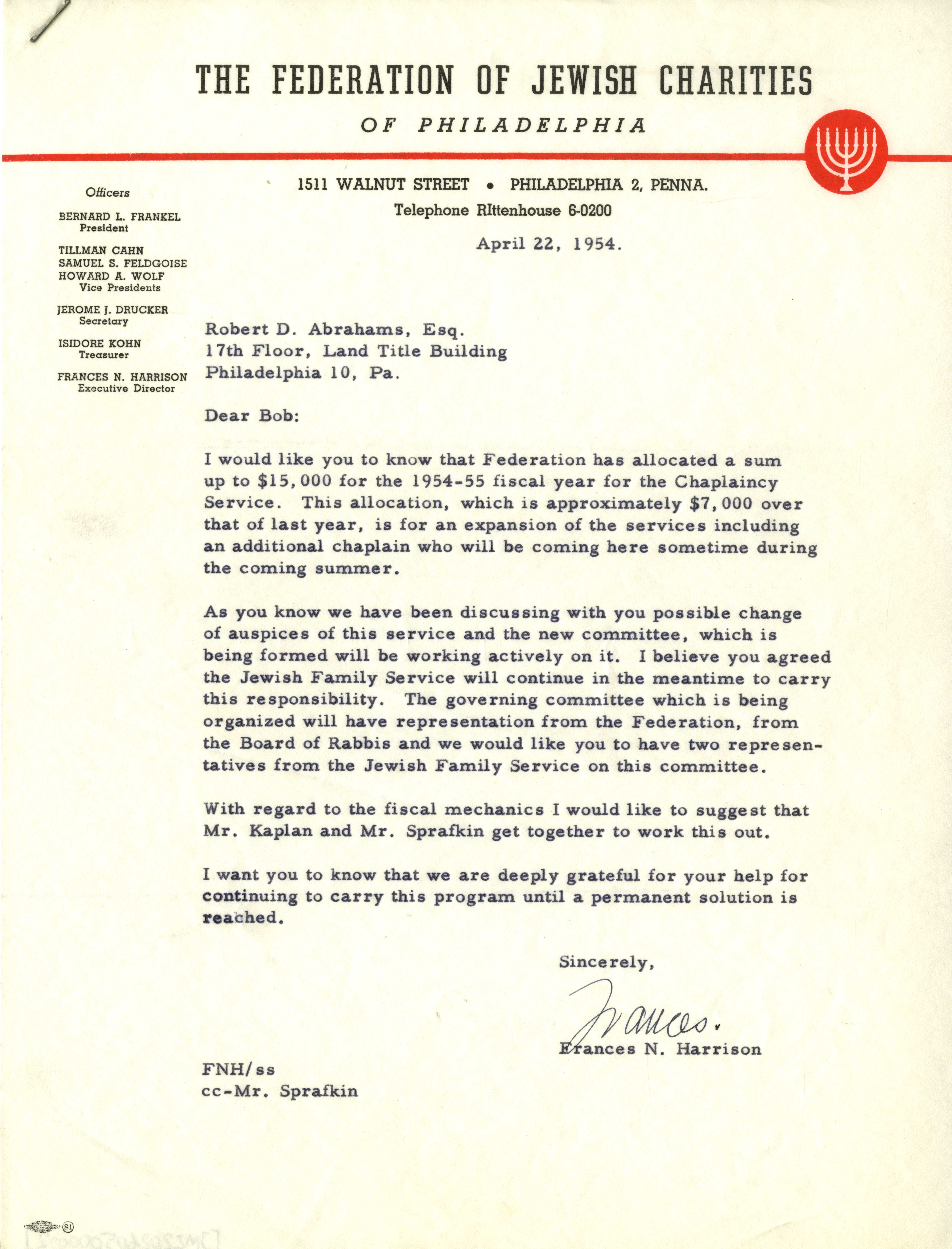
Organizations like The Jewish Federation gave money each year to sustain Eastern State Penitentiary’s Jewish community.
Courtesy of Special Collections Research Center, Temple University Libraries, Philadelphia, PA.
1950s – 1990s: Reentering with Community Support
In 1944, the synagogue underwent a major renovation. “Jewish Chaplain” became a permanent position. Shabbat and holiday services continued with volunteers visiting weekly.
By the 1950s the Jewish incarcerated population had fallen to fewer than 20 congregants, but the community carried on.
Image: collection of Eastern State Penitentiary Historic Site, gift given in honor of Howard H. Haines, Captain of the Guards.
Sheldon Glasshofer
Sheldon Glasshofer, pictured at Eastern State Penitentiary’s Print Shop, was a member of Eastern State Penitentiary’s congregation and later served as Graterford synagogue president. In the 1990s, the Jewish Congregation at Graterford raised funds to purchase three Philadelphia houses that served as post-release residences for men of any faith leaving Pennsylvania prisons. The congregation also provided a $250 clothing stipend for prisoners who were released.
Image: Collection of Eastern State Penitentiary Historic Site, gift of Alan J. LeFebvre.
Religious Freedom in Prisons
In the early 1800s, penitentiaries were a new invention in America, and Eastern State Penitentiary, the birthplace of criminal justice reform, was the first of its kind. Believed to be a less violent penal system, the penitentiary meant large-scale solitary confinement. Over time, this vision, the penitentiary (penitence) system, spread across the world. It also kicked off the intermingling of prisons and religion.
Penitentiaries were often government institutions rooted in religious beliefs. They were influenced by the Quakers, but broadly driven by Christian beliefs, with a Bible in every cell and primarily driven by the Enlightenment reform ideals. This approach often left little room for prisoners of other faiths.
Image: Rabbi Paul Shleffar tells the Passover story during the traditional Jewish feast of Passover. Courtesy of San Quentin News.
What decade did the Supreme Court rule that a person had a right to sue for access to religious material of their choice in a prison?
Building Religious Community: The Unfinished Story
Legal protections exist on paper, but implementation varies widely across states and across facilities. Litigation over religious freedom in prison continues. Prisoners still report denial of religious diets, head coverings, access to clergy, and worship space. The question Eastern State’s founders never thought to ask—namely, whose religion, when, and where? —is still being answered in courtrooms and in prisons across America.
Interested in learning more or volunteering in your own community? Check out the following resources:
Thank you to our generous supporters who helped make this exhibit a reality.
This project is supported by a grant from the Pennsylvania Historical and Museum Commission's Keystone Historic Preservation Grant Program, a program funded by the Commonwealth of Pennsylvania.
Eastern State gratefully acknowledges the generous supporters who made this exhibition possible, including: The McLean Contributionship; Philadelphia City Fund’s 2026 MilestoneGrant Fund, supported by PECO; The Reichlin and Tuck Families; Aileen and Brian Roberts; Robert L. Freedman; and Sara Jane Elk; Jill F. Bonovitz in honor of Robert H. and Janet S. Fleisher.
Related Events
The Aaron Reichlin Restorative Justice and Faith Conversations
Made possible in part by a generous grant from The Reichlin and Tuck Families, this series brings together scholarship, performance, and dialogue to examine how faith traditions foster community, sustain people through and after incarceration, and inform conversations about reentry and justice reform.

New Exhibit Opening! Freedom through Faith: Judaism at Eastern State and Beyond
Join us for the launch of Freedom through Faith: Judaism at Eastern State and Beyond, a new exhibit that will reveal how religious freedom, framed as "unalienable rights," was a foundational promise of the Declaration that was strongly represented and practiced inside America’s first penitentiary, especially among its Jewish population