We believe in the transformative power of art to foster conversation and catalyze change.
Since 1995, we have worked with more than 100 artists, commissioning work that speaks to both Eastern State Penitentiary’s history and the impact of the American criminal justice system today.
There are 14 art installations currently on view at Eastern State Penitentiary Historic Site—each offering a distinct, thought-provoking perspective.
NEW FOR 2026: ReVision: Art and Justice
A new multi-year artist residency and exhibition series spotlighting justice-impacted artists.

Featured Installation
Presented in collaboration with Mural Arts Philadelphia.
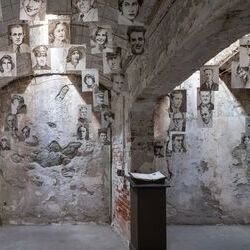
Pyrrhic Defeat is a portrait series by Mark Loughney that humanizes incarcerated individuals and exposes the deep human costs of mass incarceration. The series offers intimate, dignified portraits that challenge the stigmatizing image of people within the prison system.
The title draws from the Pyrrhic defeat theory, which argues that the criminal justice system is designed to fail at rehabilitation and crime prevention—benefiting those in power and fueling a $180 billion prison industry.
In the latest phase of Pyrrhic Defeat, the project will expand to include portraits of criminal justice reform advocates, emphasizing both people directly impacted by incarceration and people working to dismantle the system. Loughney’s evolving work underscores that meaningful reform is a collective effort.
To learn more about the artist and how to have your portrait drawn for inclusion in this growing installation, visit loughneyart.com or @loughneyart on Instagram.
All Installations on View
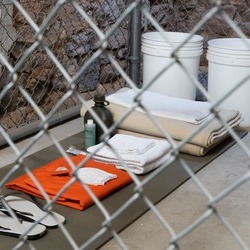
William Cromar: GTMO
A recreation of a cell from Camp X-Ray, the now-abandoned holding cells in the United States Federal Detention Center at Guantanamo Bay, Cuba.
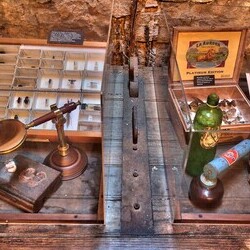
Greg Cowper: Specimen
A collection of more than 500 insect and invertebrate specimens, inspired by a collection of eighteen species of butterflies and moths gathered by an Eastern State Penitentiary prisoner living in solitary confinement.
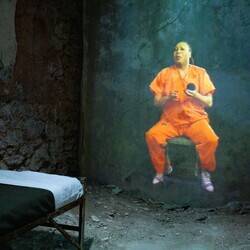
Michelle Handelman: Beware the Lily Law
A video projection that uses the 1969 Stonewall Riots as a starting point to address issues facing LGBTQIA+ prisoners.
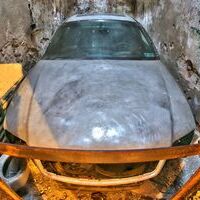
Tyler Held: Identity Control
A stripped car inside a cell reflects on the idea that a man is “too easily reduced to an object” when institutionalized.
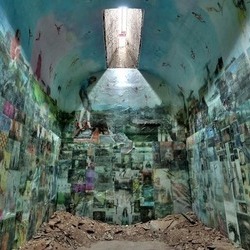
Jesse Krimes: Apokaluptein 16389067:II
A 39-panel surreal landscape offering a visual narrative of the artist’s time in prison—created using bed sheets, hair gel, and newspaper and magazine clippings and mailed home piece by piece.
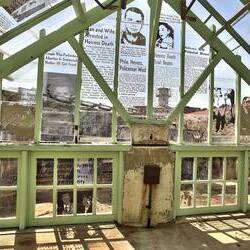
Rachel Livedalen: Doris Jean
Removable vinyl lettering and images on the glass panes of the historic greenhouse tell the story of the high-profile case of heiress Doris Jean Ostreicher.
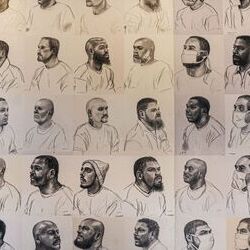
Mark Loughney: Pyrrhic Defeat
A mural of portraits humanizing incarcerated individuals and shedding light on the immense human cost of mass incarceration in America.
Image: Pyrrhic Defeat: A Visual Study of Mass Incarceration, © 2024, Mark Loughney. Presented in Collaboration by Mural Arts Philadelphia and Eastern State Penitentiary Historic Site.
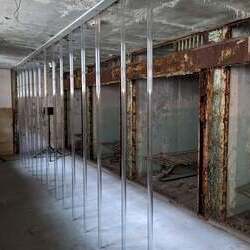
Mark Menjivar: DLP Mirror
A multi-channel sound and architectural installation brings to light the story of David Lee Powell and the musical score he composed while incarcerated on death row in Texas.
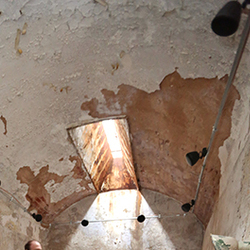
Jess Perlitz: Chorus
An overlapping cacophony of songs responding to the artist’s question to incarcerated people throughout the United States: “If you could sing one song, and have that song heard, what would it be?”
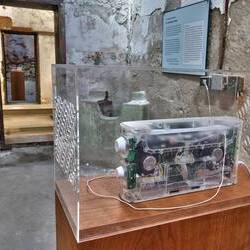
Provisional Island: An Electric Kite
A handmade radio transmitter in one cell transmits fragments of prison radio broadcasts to portable radios in the cell directly opposite highlighting the often-subversive role of radio in prisons.
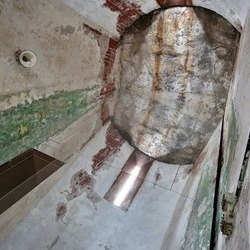
Ann Reichlin: Transient Room
A reflective plane installed in a cell explores the contradictions inherent in Eastern State Penitentiary’s architecture and historic practices.
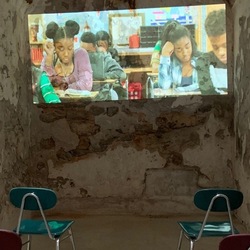
Dehanza Rogers: #BlackGirlhood
A video projection highlights the criminalization of Black girlhood, the school to prison pipeline, and the sexual abuse to prison pipeline.
Cindy Stockton Moore: Other Absences
Fifty portraits that represent individuals murdered by people who would eventually be sent to Eastern State Penitentiary.
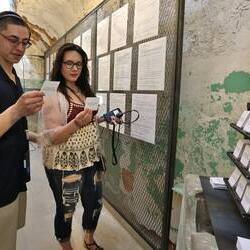
Solitary Watch with Jean Casella, Jeanine Oleson and Laurie Jo Reynolds: Photo Requests from Solitary
An ongoing project that invites people in long-term solitary confinement in U.S. prisons to request a photograph of anything at all, real or imagined, and then finds volunteers to make that image.