Justice 101: Examining the Justice System and the Unfinished work of the Founding and the Prisoners’ Rights Revolution
Thursday, December 03, 2026
2:00 - 3:00pm EST

Session is for high school, college level students, teachers, and learners of all ages.

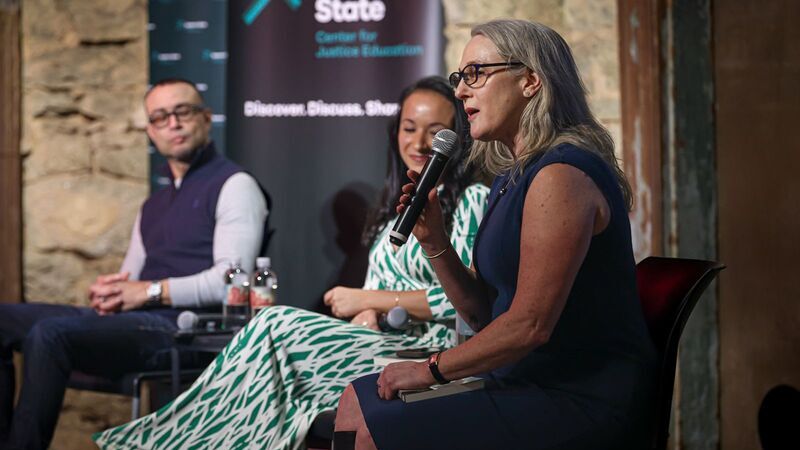
A century after American courts embraced the idea that incarcerated people had no rights the law was bound to respect, this panel returns to the Enlightenment premise at the heart of the nation’s founding: that rights are inherent, not granted by the state. Through the modern prisoners’ rights movement, incarcerated people, lawyers, religious leaders, and organizers forced the country to confront the contradiction between its language of natural rights and the realities of prison life.
The conversation will begin by looking back to the founding ideals explored in the first panel: the belief that human beings possess moral agency, dignity, and natural rights that precede government. It will then trace how those ideals reemerged in the courts and in prisons themselves, beginning with Cooper v. Pate (1964), which helped open the courthouse doors to incarcerated people, and continuing through the wave of prisoner litigation that followed in the 1960s and 1970s. Attica will serve as a defining crisis and turning point, revealing incarcerated people not as passive subjects of state power, but as citizens asserting rights, dignity, and recognition.
The discussion will also examine cases such as Holt v. Sarver and Ruiz v. Estelle, where courts used Eighth Amendment and due process language to challenge the remnants of the “slave of the state” doctrine. Alongside the legal story, the panel will consider the organizing traditions that animated the movement, including Black radical and religious prisoner organizing and the insistence that rights were not privileges to be bestowed, but claims rooted in personhood. Finally, the panel will consider the rollback embodied by the 1996 Prison Litigation Reform Act and ask whether the prisoners’ rights revolution fulfilled Philadelphia’s Enlightenment promise or exposed how unfinished that promise remains with cases today like Landor v. Louisiana Department of Corrections.
About the Panelists:
We strive to make the penitentiary and our site, programs, and exhibits accessible to all visitors. Click here to learn more about accessibility and accommodations at ESPHS.
This program is part of Justice 101, a discussion series that dives into some of the most pressing issues in criminal justice today, through a historical lens and with a focus on civic education. Each program includes interactive elements, expert voices, and opportunities for community dialogue.
This program is part of A Time for Liberty: Our Shared History, Our Shared Future, a yearlong slate of free, inclusive programs exploring the evolving meanings of liberty and justice in America. A Time for Liberty is made possible with support from civic and cultural partners including the City of Philadelphia, America250PA, Campus250, the Philadelphia Funder Collaborative for the Semiquincentennial, the Philadelphia City Fund’s 2026 Milestone Grant Fund, supported by PECO, the National Trust Preservation Fund of the National Trust for Historic Preservation, and the National Endowment for the Humanities.
Any views, findings, conclusions, or recommendations expressed in this program series, do not necessarily represent those of the National Endowment for the Humanities.